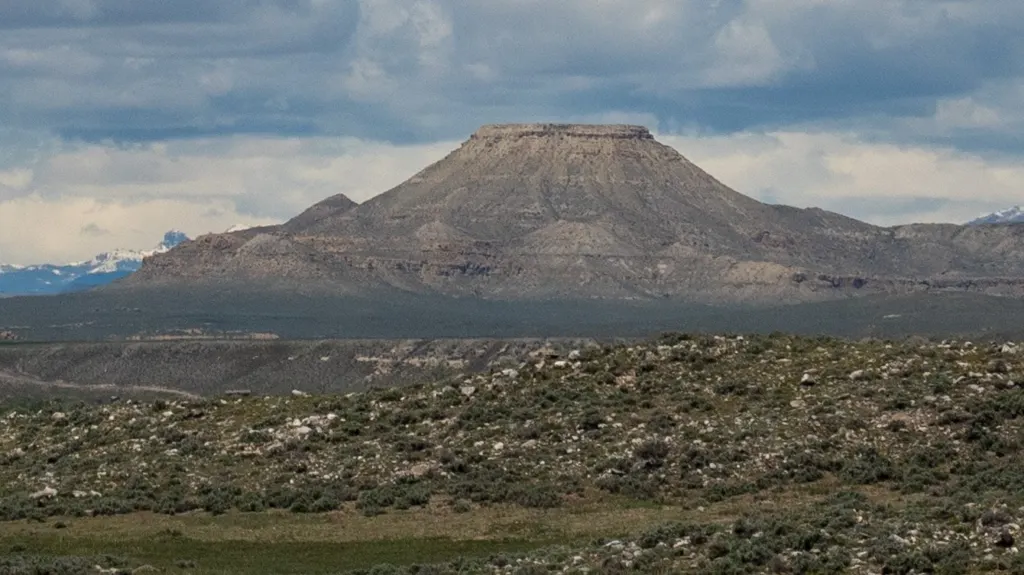
Crowheart Butte above the sagebrush country near Crowheart, Wyoming. Photo: OlyScientist / Wikimedia Commons, CC BY-SA 4.0
A Crowheart ranch that put solar-powered GPS ear tags on 350 cattle this summer found at least two predator kills it says it might otherwise have missed, according to a University of Wyoming Extension report on the first season of a field test in northwest Wyoming.
Finding those carcasses fast matters for more than herd records. Under Wyoming’s damage rules, a confirmed kill is what unlocks state compensation, and on open range in grizzly and wolf country, each confirmed calf can be paid several times over to account for calves that are never found.
What the tags showed
Nicki Nimlos, UW Extension’s state rangeland management specialist, worked with Crowheart ranchers Ben Rux, Alicia Rux and Alex Wheatcroft to tag calves, heifers and bulls in June 2026. The tags were made by CERES TAG, and the data came through Envu’s RangeView app. The Ruxes graze cattle each summer on a U.S. Forest Service allotment under a permit they share with Wheatcroft.
The idea is to read behavior. If a calf’s tag shows a burst of activity and then none at all, Nimlos said, a predation event may have happened, and a range rider can go straight to that spot.
Less than a week into the grazing season, the Ruxes used the data to find a calf that had wandered from the herd and stopped moving. The carcass was later confirmed as a grizzly kill. Ben Rux said a 10% calf loss to predators is not unusual on the allotment, where the summer grazing season overlaps with high grizzly and wolf activity.
“One challenge we have had is the predator pressure causing the cattle to move long distances in really short order, which can happen easily without our range riders knowing for a few days,” Rux said in the UW report. This summer, he said, “we knew immediately when the tags updated that the cattle were not where they belonged.”
The tags had problems, too. The ranch reported tags falling out, batteries running down and infections around tag sites. Nimlos told Wyoming Public Media the tags used in the study start at $35 a head plus a monthly subscription, and she expects more ranchers to try them as prices fall.
Why a confirmed kill is worth more than one calf
Wyoming Game and Fish pays ranchers for livestock killed by trophy game animals and wolves under Commission Chapter 28. In open-range settings, where missing calves are hard to find, the rule uses a multiplier. For each calf the department confirms was killed by a grizzly, black bear or mountain lion in grizzly country, the award is 3.5 times the calf’s value. For each calf confirmed killed by wolves where wolves are trophy game, it is seven times. The payment can never exceed the ranch’s total known death loss minus losses from other causes.
That makes the first confirmation the hard part. “Finding a kill quickly is critical to having the evidence necessary” to confirm wolf or grizzly damage, Rux said in the UW report.
The bill is large. Game and Fish paid $958,484 for livestock killed or maimed by grizzlies in fiscal 2025, and the whole wildlife damage program cost $3.29 million against a $500,000 damage fund, Cowboy State Daily reported from the department’s annual report. The fiscal 2026 report is expected in November or December.
Better tracking will not settle the larger fights over grizzly management or federal grazing policy, including the proposed rewrite of Forest Service grazing rules. What it can do is shorten the time between a kill and a ranch hand standing over it.
Nimlos plans to keep working with the Ruxes on a rangeland monitoring and grazing-use project built on the ear tag data. For more on the business of running cattle in the region, see our look at Johnson County ranchers shipping early in the drought and the rest of our Ranch & Range coverage.
Add Read the West as a preferred source on Google (opens in a new tab)