 By
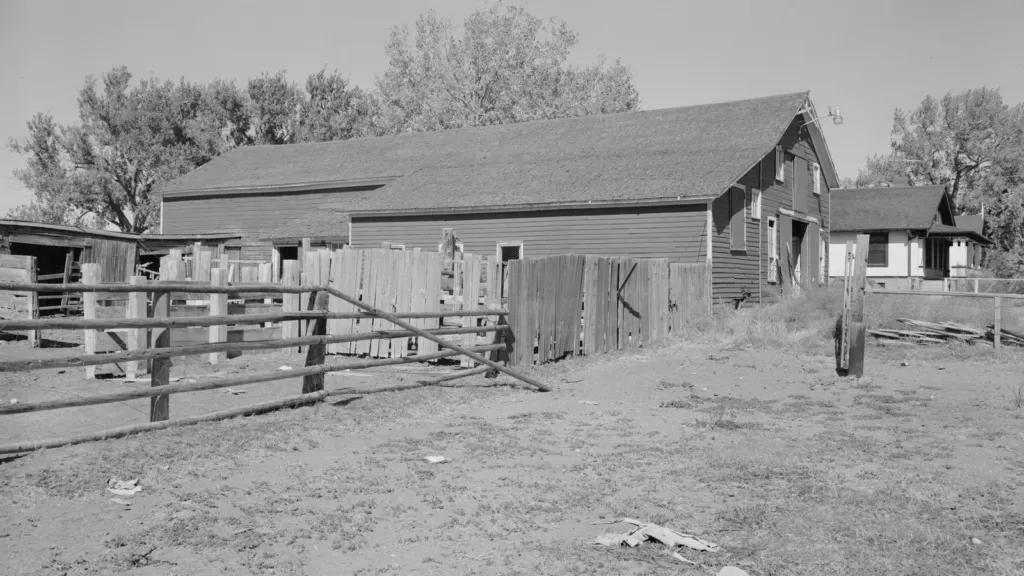
The Swan Land and Cattle Company barn at Chugwater, photographed for the Historic American Buildings Survey. Photo: Jack Boucher / Wikimedia Commons, public domain
Drive north from Cheyenne on Interstate 25 for about an hour and you reach Chugwater, a town of a few hundred people on Chugwater Creek. Just off State Route 313 stands a group of barns, a frame office, a mercantile and a manager’s house that once ran one of the biggest cattle operations in the American West.
The Swan Land and Cattle Company headquarters is a National Historic Landmark, and the Historic American Buildings Survey documented it in detail in 1974. The survey’s record at the Library of Congress calls the company “among the largest, most impressive and most important operations of that brilliant but short lived period of western capitalism, the American range cattle industry.”
Its story, told in full by historian Rebecca Hein for WyoHistory.org, is a lesson in what happens when outside money chases a boom on numbers nobody can check.
Alex Swan and the open range
Alexander Hamilton Swan was born in 1831 near Pittsburgh and settled in Iowa before moving his family to Wyoming Territory in 1874, where he filed on a homestead on Chugwater Creek. With his brother Thomas he formed Swan Brothers and spent the next several years buying land and cattle. He was elected president of the Laramie County Stock Association, the forerunner of the Wyoming Stock Growers Association, and served a term in the territorial legislature.
Those were boom years. From about 1870 into the early 1880s, a steer that cost less than $2 to raise could sell for $35 to $60, and herds grazed public grass for free. Investors in New York, Boston, London and Edinburgh wanted in.
A Scottish agricultural expert, Thomas Lawson, inspected Swan’s ranches in 1882 and reported that his companies were grazing nearly 100,000 head on about 4.5 million acres. In spring 1883 Swan went to Edinburgh, and on March 30, 1883, the Swan Land and Cattle Company Ltd. was registered in Scotland with $2.6 million to $2.9 million in capital. Swan was hired as manager at $10,000 a year.
At its peak in the mid-1880s, the company’s range reached from Chugwater west to the North Platte River and north toward present-day Casper, roughly 3.7 million acres by one estimate, or nearly 6% of Wyoming.
The problem with “book count”
Open-range herds were never fully counted. Managers kept a “book count,” a running tally of calves branded and animals sold, minus estimated losses. It was the accepted practice, and it was easy to inflate.
The company paid dividends of 9% and 10% in its first two years. Then prices fell, from an average of $40.67 a head in 1884 to $26.34 in 1886, when the company paid nothing. Directors suspected the herd Swan sold them had been overcounted. The winter of 1886-87 settled the matter. Historians estimate 15% of Wyoming’s cattle died, and a Swan foreman put the company’s loss at 25% or more.
The board fired Swan in May 1887 and sued him and the other original sellers over the herd numbers. The suit failed on procedural grounds. Swan moved to Ogden, Utah, where he died in 1905. A temporary manager sent from Scotland tried to count the cattle by marking them with blue paint, which washed off.
Cost-cutting at Chugwater
In 1888 the board hired John Clay Jr., a Scottish-born livestock commission man in Chicago. Clay closed the Cheyenne office and moved the company headquarters to Chugwater, near the ranches. He cut the payroll, at one point reducing the cooks across two places from nine to one, and rented out ranches. In 1904 the company bought 15,000 sheep, and it ran cattle and sheep together until 1910.
The company moved its affairs to an American board in 1925 and reorganized in Delaware in 1926. After Clay died in 1934 it spent years trying to sell its land, which found buyers only during World War II. The company was dissolved on Dec. 20, 1951, after 68 years.
What remains at Chugwater is the working core of that empire: the barn, the office where the cashier kept the books and the manager’s house. The Chugwater Museum, open on weekends from Memorial Day through Labor Day, covers more of the town’s ranching history.
For more on the region’s cattle country, see our Ranch & Range coverage, including one family’s effort to keep a ranch near Burns, what Cheyenne Frontier Days is worth to the capital and the new ranch award at the National Western Stock Show.
Add Read the West as a preferred source on Google (opens in a new tab)