 By
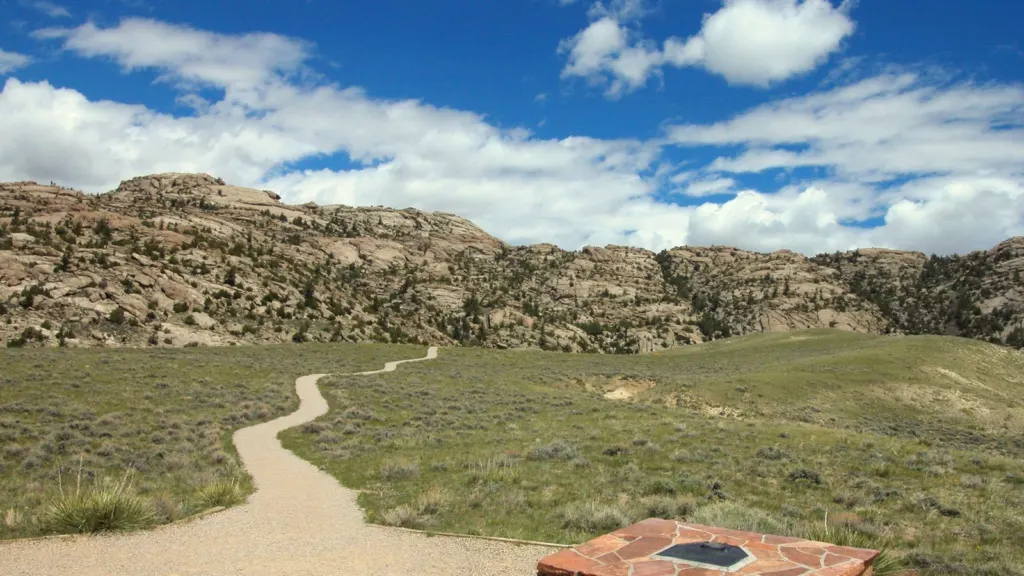
The trail into Martin's Cove, west of Devil's Gate in central Wyoming. Photo: National Park Service / Wikimedia Commons, public domain
One hundred seventy years after the Martin handcart company sheltered in a hollow of granite west of Devil’s Gate, a group of Wyoming residents is trying to settle who will own that ground for good. The plan would hand the 933-acre Martin’s Cove parcel, federal land the Bureau of Land Management has leased to the Church of Jesus Christ of Latter-day Saints since 2004, to the church outright. In return, the public would get the same number of acres of church-owned ranchland in two pieces: 358 acres beside Independence Rock and 575 acres in the Granite Mountains.
The proposal comes from Wyoming Friends for Martin’s Cove, a nonprofit that announced its formation on June 29. It would need an act of Congress. The church’s current 25-year lease, which Congress authorized in December 2003, runs out in 2029, and that deadline is the reason the group gives for starting the conversation now.
What the public would get
The larger historic prize is the 358-acre tract next to Independence Rock State Historic Site along U.S. Highway 220. According to the nonprofit, it includes about 1.9 miles of Sweetwater River frontage, roughly 131 acres of wetlands, five contributing segments of the national historic trails, and the place where the emigrant trails first crossed the Sweetwater. It also holds the site of a trading post, stagecoach stop, Pony Express station, telegraph station and military post from the trail era. The group says it can be reached directly from the highway.
The 575-acre parcel sits between the Miller Springs and Savage Peak wilderness study areas, so moving it into federal hands would close a private gap between the two. The nonprofit points to sage-grouse, pronghorn and mule deer habitat there. A consultant’s survey described the area as crucial year-round range for mule deer and pronghorn, and the ground has long been eyed for bighorn sheep reintroduction, WyoFile reported after a July tour of the parcels.
Getting there is harder. The nonprofit’s FAQ says the Granite Mountains tract is reached by two-track routes across BLM and state land north to Dry Creek Road. Lloyd Larsen of Lander, a church member and longtime legislator who is part of the effort, told WyoFile that a permanent access easement across the church’s Sun Ranch was not part of the plan at that point.
The group’s resource summary rests on a May 26 land value and resources survey and a May 16 cultural resource overview by Grouse Mountain Environmental Consultants, plus a May 21 addendum from the church’s history department. It concludes the exchange would be a net gain for the public in wildlife habitat, water, access and documented trail resources. Those reports were prepared for the proposal’s backers; the BLM has not published its own appraisal of the trade.
Why the cove matters, and why it has been contested
On Oct. 19, 1856, an early winter storm caught the Martin company, roughly 600 emigrants pulling handcarts, near a crossing of the North Platte River close to present-day Casper. Rescuers sent from Salt Lake City reached them, and the company crossed the icy Sweetwater and took refuge in the cove for five days in early November. The National Park Service estimates 100 to 125 members of the company died on the journey, and other accounts put the toll higher, Cowboy State Daily noted in a Nov. 28 look at the site’s history.
The church bought the neighboring Sun Ranch in 1996 and began welcoming visitors there. In 2002, Utah Rep. Jim Hansen introduced legislation that would have let the church buy the cove, and it drew strong opposition in Wyoming from people who did not want nationally significant public land sold to a religious organization. The compromise was the lease, reported at the time at $16,000 a year. The American Civil Liberties Union sued in 2005, arguing the arrangement endorsed religion, and the case was settled in 2006.
Historian Tom Rea, the founder of WyoHistory.org, who wrote the 2006 book “Devil’s Gate: Owning the Land, Owning the Story” about that fight, told WyoFile this summer that “the church is offering a really nice deal,” especially if the church keeps managing the cove well and guarantees public access.
Who is behind it, and what comes next
The nonprofit’s president is Ryan Lance. “As the current lease approaches expiration, this is the right time to pursue a permanent, Wyoming-led solution for the management of the site,” he says on the group’s website. The group says it is independent of the church and includes members who are not Latter-day Saints. WyoFile reported that its listed supporters include former governors Matt Mead, Dave Freudenthal and Mike Sullivan, and Rob Wallace, who oversaw federal lands at the Interior Department during the first Trump administration.
Visitors would still be welcome at the cove, the group says, and the church would take on the costs of running it. Backers have said they wanted to hear the objections before a single-subject bill goes to Congress. As of this weekend, the group’s website still describes the exchange as a proposal and does not point to a bill. For other public land questions in the region, see our recent coverage of Teton County’s request to pull Togwotee-area parcels from a BLM lease sale, the proposed Forest Service grazing rule and storage at the North Platte reservoirs downstream of the Sweetwater, and more in Ranch & Range.
Add Read the West as a preferred source on Google (opens in a new tab)