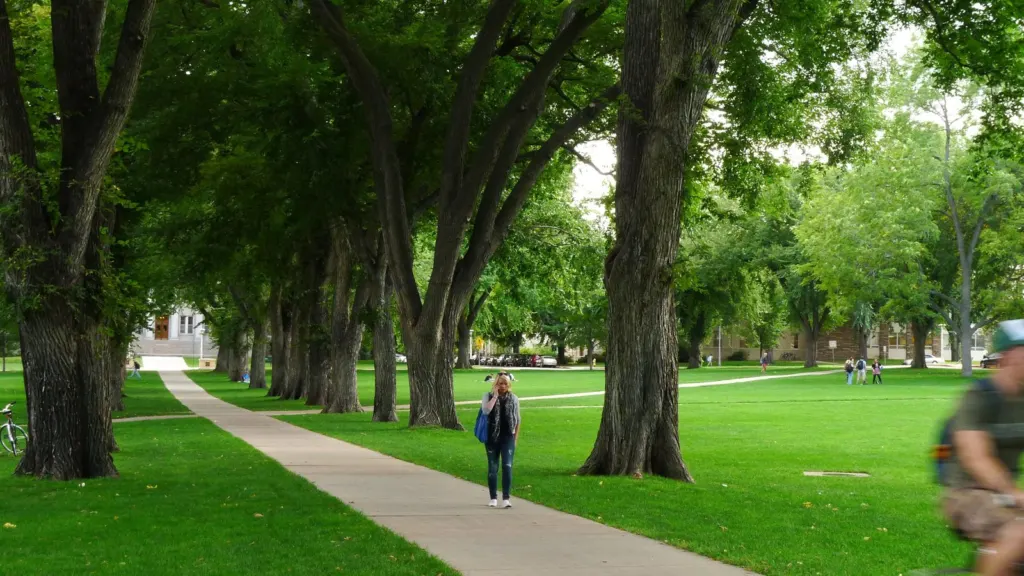
The Oval at Colorado State University, the campus landmark that inspired the sculpture Ab Ovo. Photo: Spilly816, CC BY-SA 3.0, via Wikimedia Commons.
A 28-foot stainless-steel sculpture that turns Colorado State University’s Oval on its end is scheduled to go up Dec. 1 on the lawn east of Spruce Hall in Fort Collins, the first of two new outdoor works coming to campus for Colorado’s 150th year of statehood.
The piece, Ab Ovo (From the Egg) by Longmont artist Mario Miguel Echevarria, is one of three sesquicentennial artworks CSU is adding, according to a Nov. 19 university announcement. The first, a mural in the Lory Student Center, went in over the summer. A sculpture for the Annual Flower Trial Garden is due in spring 2027.
The CSU works are part of a state-funded project placing 21 public artworks at 14 state-owned locations around Colorado, all by Colorado artists, said Jessica Kramer, who chairs CSU’s Public Art Committee. “The idea was for the art to convey Colorado’s identity in all its forms,” Kramer said in the announcement.
An Oval that stands up
The Oval is experienced flat, across the lawn. Ab Ovo turns that shape vertical, a structure visitors can see from several angles and walk through. At its center, a colorful human figure appears to step through a portal, a nod to growth and new beginnings, the university said.
“Just a Frisbee throw away from the art site is the iconic and stunningly beautiful CSU Oval,” Echevarria said. “‘Oval’ comes from the Latin word for egg, ovum. As a result, oval and ovum are inextricably linked.”
Echevarria developed the idea while his son and daughter-in-law were expecting their first child, according to CSU, and saw a common thread in CSU’s founding, Colorado’s statehood and a new arrival in the family.
The site sits near the location of CSU’s original claim shanty, the small brick building put up to claim the land for Colorado’s land-grant school before formal construction began. Campus planners worked with university archaeologists and consulted History Colorado so the installation would not disturb the archaeological site, keeping it at least 25 feet away, the university said. CSU described that corner of campus, near College Avenue and Laurel Street, as the place where the university was founded.
A mural at the student center
Denver artist Corinne Trujillo’s mural ¡Viva la Historia!, now up in the Lory Student Center, draws on research into Hispanic and Latino people connected to Colorado. Among them is Miguel Maestas, who in 1914 was denied entry to a nearby school in Alamosa and told to attend the district’s segregated “Mexican school.” His father, Francisco Maestas, joined other families in challenging the policy in court, a case historians now count among the country’s earliest Mexican American school desegregation suits.
The mural also honors Jovita Vallecillo Lobato, the first Mexican American to graduate from CSU, in 1936, and the late Mary Ontiveros, who spent more than 50 years at the university as a student, staff member and its founding vice president for diversity.
“Great art makes Coloradans know that we all belong in our Colorado,” Gov. Jared Polis said at the mural’s unveiling, according to CSU.
An upside-down aspen for the Trial Garden
The third piece, Denver artist Lauri Lynnxe Murphy’s June’s Grove, is a steel sculpture of an upside-down aspen, roughly 10 to 12 feet tall, inspired by the clonal aspen groves near Kebler Pass. The trunk and leaves will carry impressions taken from real Kebler Pass aspens, and the piece will include nesting sites for birds and pollinators. Murphy is working with Chad Miller, the CSU landscape horticulture professor who coordinates the Trial Garden, to fit it into the garden. The work is a tribute to her mother, June, who died last fall.
The art arrives during a year of change at the top for the university, with President Amy Parsons stepping down Dec. 31. For more on the campus community, read our remembrance of climatologist Nolan Doesken and the Larimer Chorale’s 50th season, and find more in our Community section.
Add Read the West as a preferred source on Google (opens in a new tab)