
 By
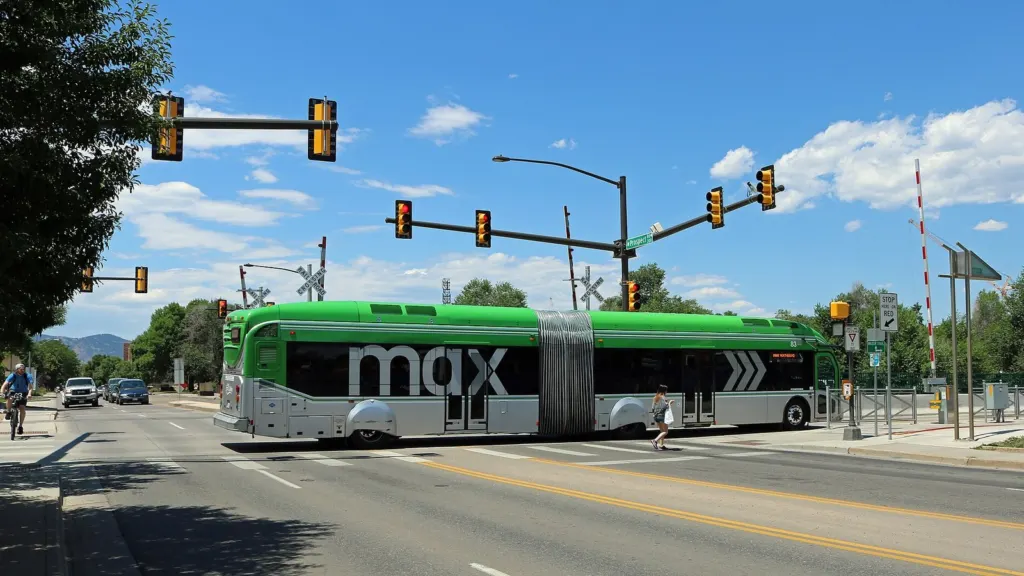
A Transfort MAX bus at West Prospect Road in Fort Collins. Photo: Jeffrey Beall, CC BY 4.0, via Wikimedia Commons.
Fort Collins police want speed cameras to start ticketing at 10 mph over the limit instead of 11, and they want all 21 of the city’s speed corridors kept as they are. City Council takes up the request at its work session Tuesday night, Nov. 10.
The item is listed on the council’s agenda planning calendar as a code update covering AVIS speed and red-light cameras and the designation of speed corridors. AVIS stands for Automated Vehicle Identification System, the state’s term for traffic cameras. Work sessions don’t produce votes. Council members will tell staff whether to proceed, and the calendar already has an ordinance updating the municipal traffic code and adopting the corridor designations penciled in for first reading Dec. 1.
What police are asking for
The proposals are laid out in the agenda materials, which the Fort Collins Report summarized before the meeting. Police say the changes would line the city’s code up with Colorado’s AVIS law:
- Lower the standard camera threshold to 10 mph over the posted limit, which state law allows and which police say neighboring cities already use. A driver going 45 in a 35 would qualify.
- Allow camera citations at 6 to 9 mph over in school and construction zones.
- Drop the rule that a citation needs an identifiable photo of the driver and send it to the registered owner instead, with exceptions for stolen or sold vehicles and owners who have died.
- Handle speeds 25 mph or more over the limit through the camera system as a civil penalty mailed to the owner, rather than having an officer track down the driver.
- Add authority for school bus stop-arm cameras, which state law now permits.
- Create a citywide steering committee to direct camera revenue toward traffic safety.
- Replace the required report to council every two years with a report only when police want to change a corridor.
The crash numbers
Police compared crashes at six intersections with fixed red-light and radar cameras over about 18 and a half months before speed citations began in December 2024 and about 18 and a half months after. Reported crashes fell from 184 to 169, or 8.2%. Four intersections improved, led by Shields and Mulberry, which dropped from 24 crashes to 15. Two got worse. College Avenue and Drake Road went from 40 to 52, and Shields and Harmony went from 14 to 16.
That is a before-and-after count, not a controlled study. The materials don’t break crashes down by severity or account for changes in traffic volume, so they don’t show that the cameras caused the changes either way.
Speed vans have issued 68,338 tickets in the corridors since January 2021. Three Tier One corridors account for about half of the Tier One total: Prospect Road from Taft Hill Road to Interstate 25 with 10,283, Lemay Avenue from Prospect to Trilby Road with 10,140, and College Avenue from Laurel Street to Carpenter Road with 6,886. Officers wrote another 8,631 speeding and reckless-driving tickets in Tier One corridors over five years.
The corridors date to 2024 and are part of the city’s Vision Zero goal of ending traffic deaths and serious injuries. The city’s traffic enforcement page has more on how the program works. Council’s Vision Zero progress update is set for its Dec. 8 work session.
For more on the region’s other big road project, see what’s open on the I-25 North express lanes between Berthoud and Fort Collins.
Add Read the West as a preferred source on Google (opens in a new tab)