
 By
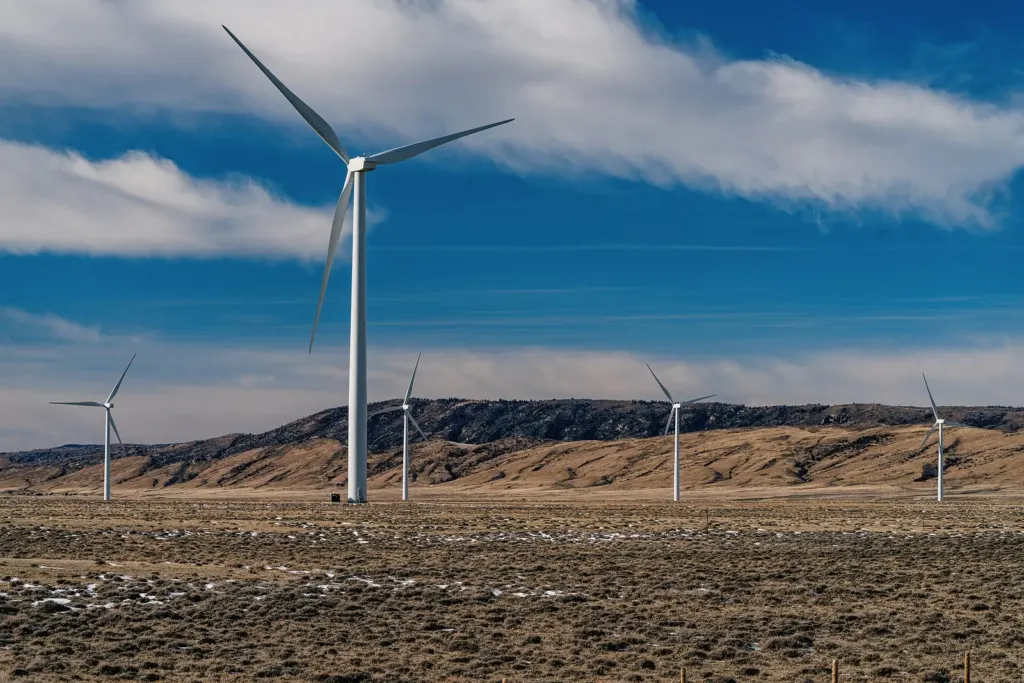
Wind turbines near Medicine Bow, Wyoming. Photo: Tony Webster via Wikimedia Commons, CC BY 2.0
Wyoming has formally approved the Laramie Range Wind Project, the 650-megawatt wind farm planned for the Horse Creek country northwest of Cheyenne. What the developer does with that approval is less clear.
The state Industrial Siting Council issued its final order on Monday, Oct. 26, Cowboy State Daily reported. The permit carries 26 binding conditions set after a contentious two-day hearing in September. Earlier this month, ConnectGen Laramie County, the affiliate of Spanish energy company Repsol that is developing the project, pulled its conditional use permit applications from Laramie County. It plans to refile early next year.
So the project now has its state permit and no pending county application, and at least one county official suspects the state’s conditions have changed the math.
The conditions
The order requires a 2.5-mile buffer between turbines and neighboring homes. It also limits high-capacity well drilling near the project boundaries, requires bird-detection systems and says road agreements must be fully executed before construction starts. Repsol must hire an independent engineer to decide what road changes, if any, the project needs.
The council also set aside up to $11.7 million in impact assistance for local governments, fire districts and other public entities in Laramie and Platte counties. That money comes from state sales and use taxes on construction materials and is meant to cover “unmitigated impacts which are directly or indirectly attributable to construction of the industrial facility,” the permit says. The statutory cap for a project this size is $14.97 million.
Justin Arnold, head of the Laramie County Planning Commission, said the extra mile of setback is why the developer stepped back from the county process. “It sounds to me from the information I’ve been provided that the conditions placed on their permit made the project, to some extent, unviable for the applicant,” he told Cowboy State Daily. “Their intent is to go back before the Industrial Siting Council for an amendment to their existing application.”
Repsol spokesperson Christi Schaefer said the withdrawal gives the company time to “review and incorporate the final ISC requirements” into new county applications. She did not yet have details on any next steps with the siting council.
How it got here
The original proposal called for up to 170 turbines on about 56,000 acres. Laramie County commissioners rejected it 3-1 in September 2025 after a long hearing, citing open questions about road access, fire mitigation and water well permits. The company came back with a smaller plan, up to 139 turbines on about 41,000 acres of private and state land. That is still a footprint larger than the city of Cheyenne.
Whatever happens at the state level, the county gets the last word. Commissioners will have to decide whether the project is a net benefit, and Arnold said they are doing that while a lot of other development proposals arrive at once. “We’re in unprecedented times with the volume of proposals coming through at the same time,” he said. “We’re having to not only look at this project but the cumulative impact.”
Ranchers on both sides of the fence
The fight has split ranch families who have worked the same ground for generations.
Wendy Volk, a Cheyenne real estate agent whose family owns land in the area, has been one of the most outspoken opponents. “Our family has six generations of roots in Horse Creek,” she said. “We want to see meaningful protections, not simply promises of future coordination.” Volk said the conditions address much of what came up at the hearing, from road safety to wildlife and site restoration, but “much depends on how they are interpreted, implemented, monitored, and enforced.” She also pointed to a discrepancy in the order, which cites a 2.5-mile setback in one place and 1.5 miles in another. “That discrepancy needs clarification,” she said.
On the other side is Charlie Farthing, whose family has ranched near Iron Mountain since 1903 and who has leased land for the project. For him, turbine lease payments are a steady check in a cattle business that runs in cycles. “I’ve got grandkids, and I hope that they have the opportunity or want to come back,” he has said. “That’s a lot of the reason we’re doing this.”
That argument, a lease as a way to keep the place in the family, comes up wherever wind and solar developers court landowners in the West. So do the counterarguments about narrow county roads, scarce water and stretched volunteer fire departments. The Laramie Range project has now put both in front of the state and, soon enough, back in front of the county.
Our earlier comparison of what a household pays in taxes in Colorado and Wyoming covers how each state raises its money.