 By
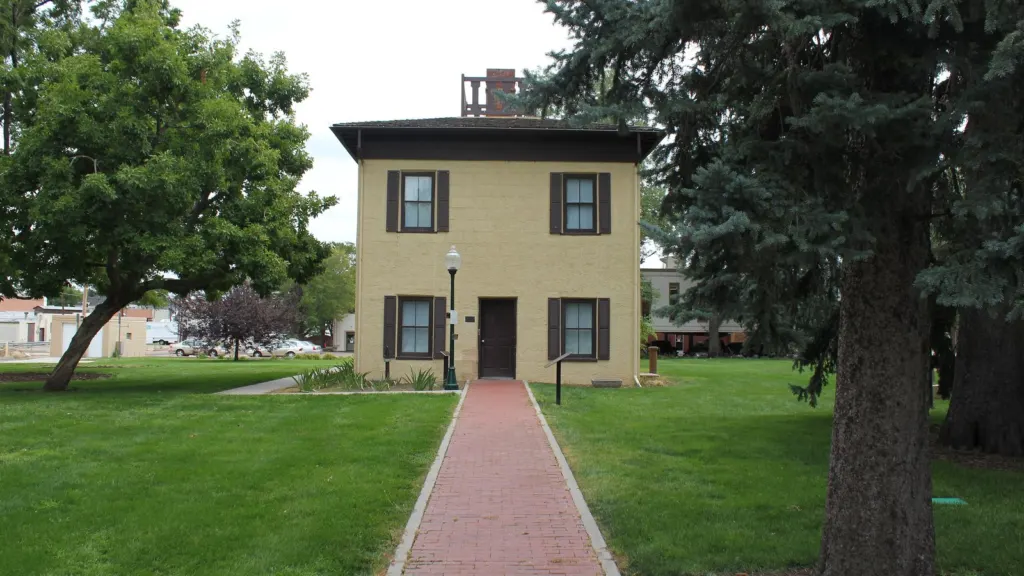
The Meeker Home in Greeley, built in 1870 and now the city's oldest building. Photo: Jeffrey Beall from Colorado, USA, CC BY-SA 2.0, via Wikimedia Commons.
Nathan Meeker never planned to stay small. When he built his house in Greeley in 1870, he put it well away from the center of a town that barely existed yet. The city’s own historic inventory says he did it on purpose, to show settlers he expected the town to grow out to meet him.
It did. The two-story adobe at 1324 Ninth Avenue is now the oldest building in Greeley, and the colony Meeker organized is one of the reasons Northern Colorado looks the way it does.
A newspaperman’s colony
Meeker was the agricultural editor of Horace Greeley’s New York Tribune when, in 1869, he organized a joint-stock company called the Union Colony. The idea was to plant a farming town in the West built on four things: temperance, religion, agriculture and irrigation.
People who were picked to join paid a $155 membership fee to Greeley, who served as the company’s treasurer, according to the City of Greeley’s historic property record for the Meeker Home. The colony used that money to buy land where the Cache la Poudre River meets the South Platte. The town was laid out in April 1870 and named for the editor who had put his name and his paper behind it.
It worked better than most Western colony schemes. The colonists dug irrigation ditches off the Poudre early, and those ditches turned dry bottomland into farms. The water rights and canal companies that grew out of that era still shape where Northern Colorado’s water comes from and who gets it.
The house and the debts
Meeker’s house was built of adobe, but not quite the adobe of the Southwest. The city record notes that the bricks were smaller, closer to European brick sizes, and the house was finished in an Italianate style with a hipped wood-shingle roof, a balustrade and tall two-over-two windows. Meeker lived there with his wife, Arvilla, and daughters Rozene, Josephine and Mary. His son Ralph, a reporter in New York, visited often.
From 1870 to 1878, Meeker started and edited the Greeley Tribune and pushed what the record calls “village improvement campaigns.” He was a builder of institutions more than a businessman, and the money never came easy. He fell further into debt, and after Horace Greeley died in 1872 he lost his most important backer.
White River
In 1878 Meeker took a federal job as Indian agent at the White River Agency in northwestern Colorado. It paid a salary and gave him a new place to try the kind of planned farming community that had worked in Greeley.
It went badly. Meeker insisted that the White River Utes give up their way of life and take up farming, and the conflict grew. On Sept. 29, 1879, Ute men killed Meeker and the other agency employees, and his wife and daughter Josephine were taken captive. They were released 23 days later. The killings were used to push the Utes out of most of western Colorado, a story told from the other side in our profile of Chief Ouray and the Ute fight to hold Colorado land.
The city record is blunt about it: Meeker “was unable to bridge the cultural gap.” It also notes that Josephine, who lived through the captivity, came to understand the causes of the conflict and was sympathetic to the Utes.
What happened to the house
Arvilla and Josephine came home to Greeley and kept the family going by taking in boarders and growing their own food. Rozene and Josephine went on lecture tours about White River. Josephine died in 1882 and Mary in 1883. Arvilla lived in the house until 1904 and died the next year. Rozene sold it in 1910 to cover mortgage payments.
The City of Greeley bought the property later and opened it in 1929 as the city’s first museum. It was added to the National Register of Historic Places in 1970.
The Meeker Home Museum is closed for now, and the city has not posted a reopening date. Visitors can still walk the grounds and read the outdoor panels, or take the free virtual tour on the museum’s page. The Greeley History Museum at 714 Eighth St. covers the Union Colony in its permanent exhibit.
Why he still matters
Greeley still argues about the kind of growth Meeker bet on, from the end of the Catalyst project to how the city pays for itself. A town in Rio Blanco County carries his name, near the site of the agency where he died. For more founders and builders of the region, see our Entrepreneurs section.
Add Read the West as a preferred source on Google (opens in a new tab)