 By
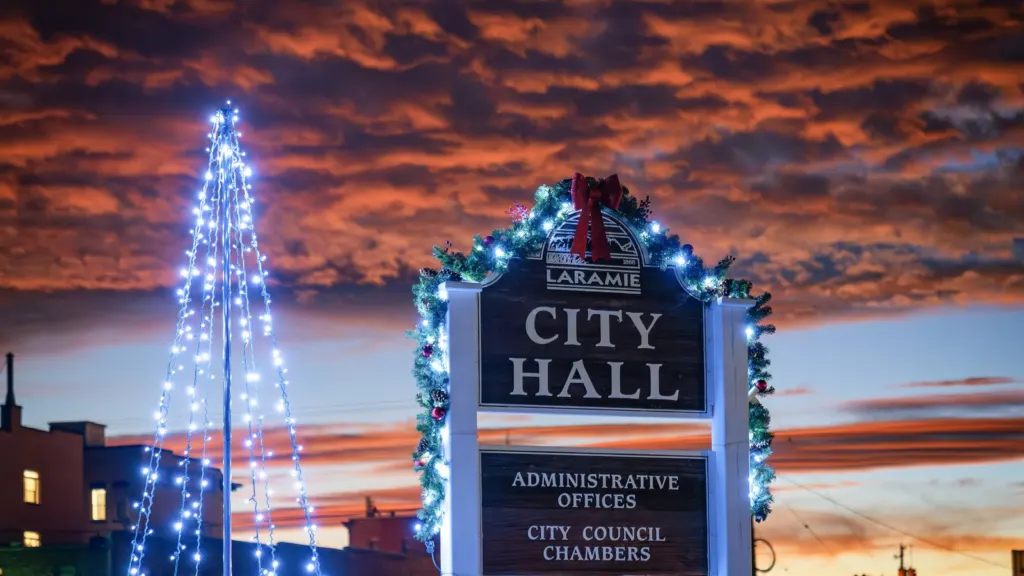
The sign outside Laramie City Hall, where the council meets. Photo: Tony Webster / Wikimedia Commons, CC BY 2.0
Laramie has never had a large data center proposal on its desk. The city wants rules in place before one arrives, and the City Council is set to take its final vote on them Tuesday, Dec. 1.
Original Ordinance No. 2127 is on third reading at the council’s Dec. 1 regular meeting, which starts at 6:30 p.m. at City Hall, 406 Ivinson Ave. Staff are recommending a substitute version, 2127B, with a handful of wording changes made after the council’s Nov. 17 second reading.
The planning department’s summary for the meeting is blunt about the reason. The current Unified Development Code treats every data center as the same use, whatever its size, and doesn’t require the electrical, water, generator and cooling information needed to judge a big one. The ordinance does not ban data centers, the staff report says. It sorts them by size and sets standards.
10 megawatts is the dividing line
Under the ordinance, a small-scale data center draws less than 10 megawatts of electricity at full buildout. A large-scale one draws 10 megawatts or more. Buildings and phases under common ownership or in a common development plan count together, so a developer can’t split one campus into pieces to stay under the line.
Small facilities would be allowed by right in the IP, I1 and I2 industrial districts and would need a conditional use permit in the LM and TO districts. Large facilities would need a conditional use permit everywhere they are allowed, which puts them in front of the Planning Commission for site-specific conditions.
Every data center, large or small, would have to meet a set of baseline rules:
- Distance from homes. Where a site borders residential zoning or an existing home, buildings and outdoor equipment such as generators, cooling units, transformers, substations and battery storage must sit at least 500 feet away. The first draft said 200 feet; the council pushed it up after first reading Nov. 4.
- Generator testing. Routine testing of backup generators is limited to weekdays from 8 a.m. to 5 p.m. Generators can’t be used for everyday power, peak shaving or selling electricity to the grid.
- Water. Data centers must use closed-loop, air-cooled or other water-efficient cooling, and once-through cooling with drinking water is banned. A cap of 1.5 million gallons of city water in any 30-day period would apply unless a separate written agreement with the city sets a different limit. Water for fire suppression and fire-code testing doesn’t count.
- Drought rules and meters. Facilities must follow city water restrictions and have separate meters or another approved way to measure city water use.
Projects that need a conditional use permit would also have to submit professional noise and vibration studies covering day and night operation, low-frequency and tonal noise and equipment running at the same time, plus utility demand and capacity information, wastewater and cooling plans and full-buildout drawings. The city would check sound levels after construction, and a facility that wants more power than was studied would need a new permit. The city could also hire independent consultants to review an application, with the developer paying the documented cost.
What was left for later
Some requests from the public and councilors didn’t make this version. Staff said community benefit agreements, annual operating reports, decommissioning and bonding requirements and standards for on-site power plants could come in a future amendment, and a moratorium would take separate council action. On electric rates, the staff summary says state utility regulators, large-load tariffs and the Wyoming Office of Consumer Advocate are where ratepayer concerns get addressed.
No one spoke at the Nov. 17 public hearing on the ordinance, according to the hearing minutes. The latest changes are mostly cleanup: dropping the word “common” from the setback language, adding an explicit reference to the city’s outdoor lighting rules and excluding broadband and wireless facilities from the definition of a data center.
Laramie’s push follows a wave of data center building 50 miles east in Cheyenne, home to facilities for Microsoft, Meta and Google. Growth-related rules are a theme across the region this fall, from Wellington’s new business incentive policy to the conditions attached to the Laramie Range Wind Project‘s state permit.
The Dec. 1 agenda also includes a Vision Zero traffic safety resolution and an affordable housing fee reduction program. Meetings stream on the city’s YouTube channel and Cable Channel 191. More regional coverage is in our Local News section.
Add Read the West as a preferred source on Google (opens in a new tab)