
 By
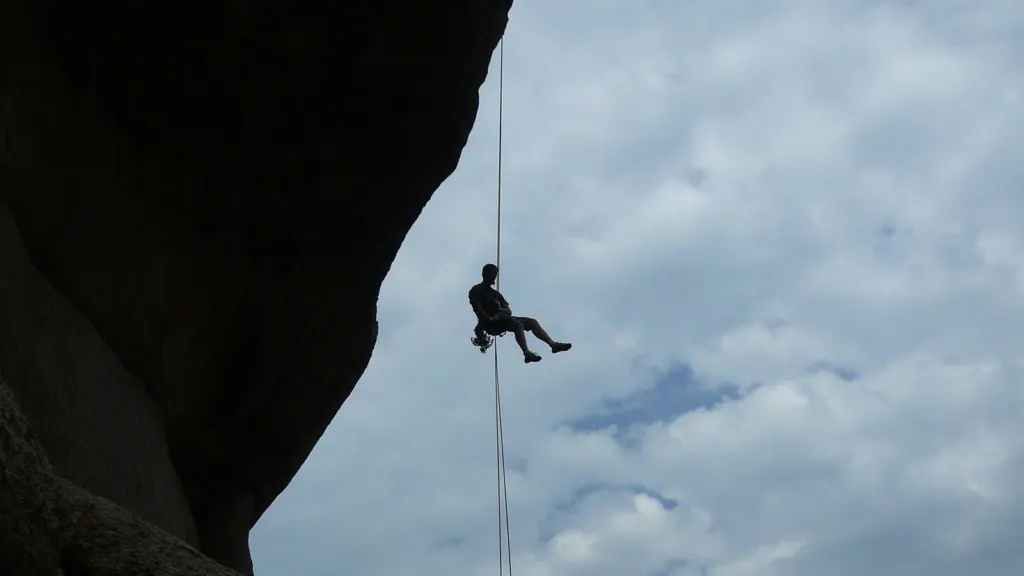
A climber rappels at Vedauwoo, the granite formations between Laramie and Cheyenne in the Medicine Bow-Routt National Forest. Photo: Tyler Smeenk, Beau Hill, public domain, via Wikimedia Commons.
Outdoor recreation produced $2.3 billion of Wyoming’s economy in 2025, or 4.4% of everything the state produced, according to figures the federal Bureau of Economic Analysis released Nov. 18. In Colorado, the same activities added $18.5 billion, a 3.2% share.
Both states sit well above the national figure of 2.3%. Wyoming tied for fourth among the states on that measure, the University of Wyoming said in a Nov. 19 summary prepared with the Wyoming Office of Outdoor Recreation. Hawaii led the country at 6.1%.
The numbers matter on both sides of the state line because they are the ones legislators, county commissioners and land managers cite when they argue over trail money, campground repairs and public land access. They also show how differently the two economies lean on the outdoors.
Wyoming’s share is bigger, Colorado’s dollars are
The BEA state tables count 17,208 outdoor recreation jobs in Wyoming, 5.7% of wage and salary employment, paying $989 million in compensation. Colorado’s outdoor economy employs 137,415 people, 4.5% of its workforce, and paid $9.64 billion.
The activity breakdowns show the difference between a hunting-and-RV state and a ski state. Snow activities added $1.75 billion to Colorado’s economy last year, against $52.9 million in Wyoming. Boating and fishing were worth $780 million in Colorado and $68.6 million in Wyoming, and RVing $562 million and $84.8 million.
Wyoming’s single largest category by value added is hunting, shooting and trapping, according to the UW summary, which said that segment grew by $3 million from 2024. RVing, boating and fishing followed. Snow sports were the fastest-growing category in the state, up $4 million.
Government spending is part of the count, too. Government expenditures, a separate line in the BEA activity table, came to $221 million in Wyoming and $1.4 billion in Colorado.
Steady, not growing fast
Holding steady is the theme of the Wyoming release, and the rankings explain why. While the state placed near the top for outdoor recreation’s share of the economy, it ranked 47th for growth from the year before.
“The sector held steady in 2025 and remains among the top states nationally for its share of the economy,” Dan McCoy, director of UW’s Jay Kemmerer WORTH Institute, said in the release. Mark Tesoro, manager of the Wyoming Office of Outdoor Recreation, called it “one of Wyoming’s biggest industries.”
Nationally, outdoor recreation accounted for $704.2 billion in value added and 5.3 million jobs, with inflation-adjusted value added up 1.9% from 2024, according to BEA.
The UW summary points to aging campgrounds, trails and roads as the main limit on growth, and singles out one project close to home: Wyoming Pathways received funding to repair the French Creek Trail in Albany and Carbon counties, in the Medicine Bow-Routt National Forest west of Laramie, which the release says should take some pressure off busier areas of the forest.
That kind of planning is under way closer to Cheyenne as well, where Curt Gowdy State Park is writing its first master plan since the 1980s, and in the Snowy Range, where the ski area west of Laramie has a new owner. For the state budget picture these numbers feed into, see Wyoming’s latest revenue forecast. More regional business coverage is on our Business page.
BEA publishes state summary sheets and detailed tables on its outdoor recreation page; its next release is scheduled for fall 2027.
Add Read the West as a preferred source on Google (opens in a new tab)