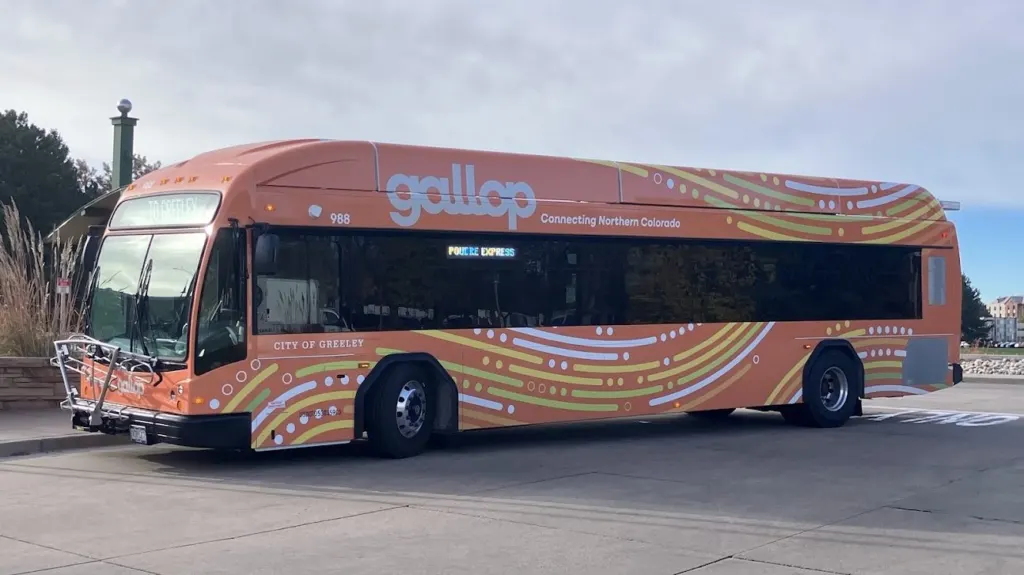
A Gallop bus on the Poudre Express route at the CSU Transit Center in Fort Collins, Nov. 5, 2026. Photo: NocoRoads, CC BY-SA 4.0, via Wikimedia Commons.
Greeley’s bus system, now called Gallop Transit, is getting $1,174,919 a year from a Colorado fund built on oil and gas production fees, its first award from the program and enough to put it in the top dozen transit agencies in the state for this round.
The money comes from the Clean Transit Enterprise inside the Colorado Department of Transportation, through what the state calls the Local Transit Operations Program, or the SB230 Formula Program. The fiscal 2027 funding notice lists every eligible agency and its share of an $80 million pot. Greeley Evans Transit, as the system was named when the table was drawn up in May, is on it at $1,174,919.
The city doesn’t have to put up matching money, and the award was announced Oct. 28, the NoCo Herald reported. “These funds will help us improve bus service starting in summer 2027,” Sage Thornbrugh, a transportation planner with the City of Greeley, told the Herald. “We look forward to sharing more as plans take shape.”
Where the money comes from
Senate Bill 24-230 created a fee on oil and gas production and widened the Clean Transit Enterprise’s job to include paying for more bus and rail service. According to CDOT’s program page, 70% of that fee revenue goes to the formula program, 20% to passenger rail, including early work on the Denver-to-Fort Collins corridor, and 10% to a smaller competitive grant program.
The biggest share stays in the Denver area: RTD alone is set to receive $44 million of the $80 million.
The formula weighs population most heavily, at 50%, followed by ridership at 20%, vehicle revenue miles at 10%, density at 10%, and local zoning and planning and disproportionately impacted communities at 5% each. The state then split the money three ways: 55% to RTD, 43% to the larger agencies, and 2% to small ones with fewer than 30,000 riders a year.
How Greeley compares
Among Northern Colorado systems in the fiscal 2027 table:
- Transfort, Fort Collins: $3,638,541
- Via Mobility Services: $1,292,051
- Greeley Evans Transit (Gallop): $1,174,919
- City of Boulder: $1,012,000
- City of Loveland: $770,901
- Boulder County: $262,833
Transfort’s award is about three times Greeley’s, a gap that follows population and ridership in the formula. Loveland, which sits between the two and adopted its own 2027 budget last month, gets about two-thirds of Greeley’s figure.
The funding rules also limit what each agency can get. The board capped awards at 20% of an agency’s operating budget, and agencies that got money in the first round were guaranteed at least a 5% increase. Because Greeley was applying for the first time, it had to submit a full plan for how it would use the money, rather than the shorter update returning agencies filed.
What the money can buy
Under state law the formula dollars go to service that wasn’t there before: new buses to expand routes, longer service hours, more frequent buses, new routes or zones, or other changes that can be shown to raise ridership. Agencies have two years from the date their contract is signed to spend it, and CDOT’s target date for signing contracts is Feb. 1, 2027.
Greeley hasn’t said which routes or hours it will change. The system is in the middle of a rebrand from GET to Gallop, and the award lands weeks after voters turned down Measure 2F, the proposed sales tax increase, earlier this month.
The next step is the grant contract with CDOT. Once it’s signed, the city has said it plans to roll out the service changes in summer 2027. More on city and county budgets is in our Local News section, including Weld County’s $660.8 million 2027 budget.
Add Read the West as a preferred source on Google (opens in a new tab)