
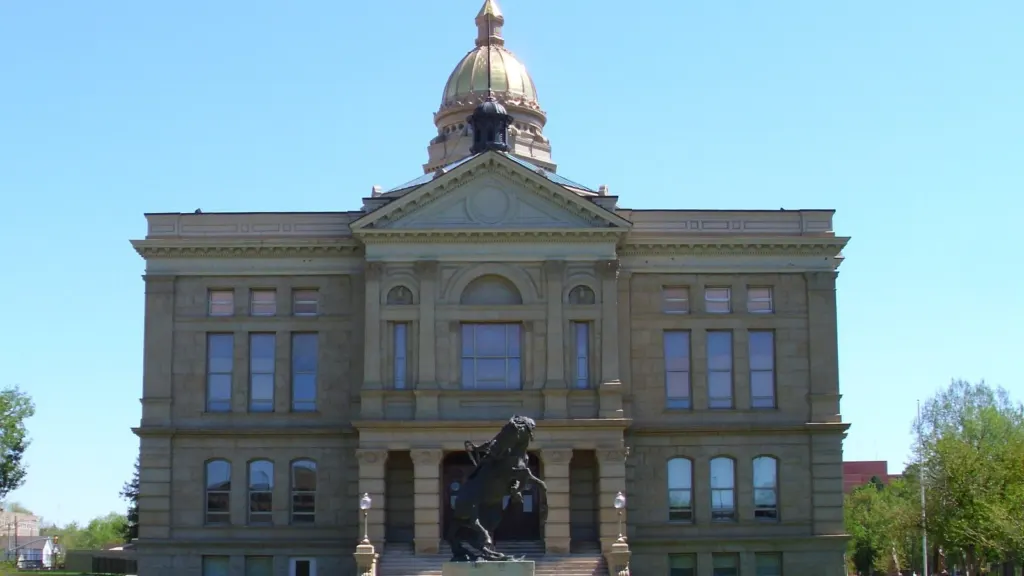
The Wyoming State Capitol in Cheyenne, where lawmakers will build the next budget on the CREG forecast. Photo: Babymestizo, CC BY-SA 3.0, via Wikimedia Commons.
Wyoming will have about $257 million more in its general fund over the next two years than lawmakers planned on in March, according to the state’s October revenue forecast, which lands just before Gov. Mark Gordon unveils his supplemental budget on Monday.
The Consensus Revenue Estimating Group report, dated Oct. 30, raised projected general fund revenue for the 2027-2028 biennium to $3.64 billion. Counting $70 million in unspent money from earlier appropriations and a small carryover, the Legislative Service Office puts the total new money available at $333.5 million.
The forecast is the number the governor and the Legislature build the supplemental budget on, so it sets the ceiling for what gets debated when lawmakers return in January.
Where the extra money comes from
Compared with the January forecast, the October numbers raise every major general fund category except one:
- Sales and use taxes: up $67.5 million, to $1.11 billion for the biennium.
- Severance taxes: up $65.9 million, to $703 million.
- Federal mineral royalties: up $60.4 million, to $424.8 million.
- All other revenue: up $65.9 million.
- Investment income: down $2.4 million.
Some of the gain is passed along automatically. Higher sales tax collections mean $9.2 million more for direct distribution to cities, towns and counties, and $12.2 million more for the Highway Fund, which is why the general fund’s net increase is $257.3 million rather than the $278.7 million gross.
Oil and sales tax did the work
The year just ended beat expectations too. Revenue for the 2025-2026 biennium came in $121.1 million above the January forecast. Sales and use tax collections hit a record $667.2 million in fiscal 2026, the report says, driven by growth in retail trade. The state treasurer’s office earned a record $1.871 billion in gross investment earnings across all funds.
Oil is the swing factor. Wyoming producers received an average of $81.02 a barrel in the first half of 2026, according to CREG, against the $55 a barrel the group had forecast in January. The group raised its oil price forecast by $25 a barrel for 2026, $10 for 2027 and $5 for 2028. It lowered natural gas prices, and it kept forecasting a long decline in coal production, though a slower one than before.
CREG co-chair Kevin Hibbard warned against treating the oil money as permanent. “You have to pump your brakes a little bit and be a little cautious, because a lot of that is attributed to Operation Epic Fury in oil prices. It’s a bubble,” he told Wyoming Public Media.
The forecast lands in a changed Capitol. Lawmakers met this month to pick leaders for the 69th Legislature, and voters on Nov. 3 rejected Proposition 1, the proposed 50% residential property tax exemption. The long decline in coal, traced in our history of Black Thunder and the Powder River Basin, remains the backdrop for every Wyoming budget.
Gordon’s supplemental budget proposal is expected Monday, Nov. 16. Lawmakers take it up in the general session that opens in January. More on state and local budgets is in our Finance section.
Add Read the West as a preferred source on Google (opens in a new tab)