 By
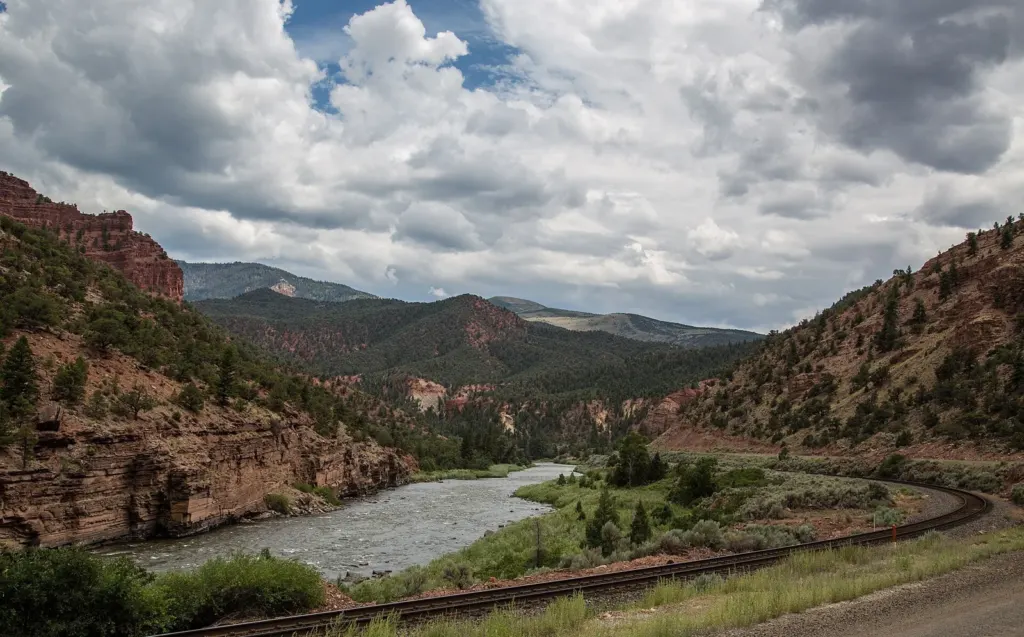
The Colorado River valley between Burns and Dotsero. Photo: Tony Webster from Minneapolis, Minnesota via Wikimedia Commons, CC BY-SA 2.0
Susan Nottingham watched what happened to the land where her parents started out. Their first ranch sat on ground that is now the EagleVail golf course, in the heart of the Vail Valley. She decided the ranch they spent six decades assembling near Burns would not go the same way.
Earlier this month, the Colorado Cattlemen’s Agricultural Land Trust announced it had closed on a conservation easement covering 18,484 acres of the Nottingham Ranch, which straddles Eagle and Routt counties along the Colorado River. The ranch stays in private hands and keeps running cattle, but it can no longer be subdivided or developed, according to the Vail Daily.
“‘A thing of beauty is a joy forever,'” Nottingham said in the trust’s announcement, quoting John Keats. “This will truly be a joy forever. My heart is full.”
Sixty-four years of putting it together
The ranch was built by Nottingham’s parents, Bill Nottingham Jr. and Neva Snook. According to the Cattlemen’s Trust, they bought their first ranch on what is now the EagleVail golf course and, over six decades, “amassed the holdings that are today the Nottingham Ranch.”
When the Routt County commissioners took up their share of the deal in September, Nottingham credited her parents. “They’re the ones that took 64 years of their married life and put this all together, and it’s because they loved their family and they loved the land,” she said. “I just could not see letting it go to ruin to somebody dividing it up and selling the water and not keeping it as it is.”
The trust said in its release that after seeing what development did to her parents’ original ranch in the Vail Valley, and to working lands elsewhere in the state, Nottingham concluded a conservation easement was the only way to make sure her ranch was spared.
“This project exists because of Susan Nottingham’s vision and determination,” Cattlemen’s Trust CEO Erik L. Glenn said. “Following in the footsteps of her parents, she has devoted her life to this ranch, to production agriculture, and to her community.”
The water and the elk
The Eagle County portion of the easement covers about 9,480 acres, roughly 4.4% of all private land in the county. It comes with 175 cubic feet per second of senior water rights dating to the late 1800s, which the easement keeps attached to the ranch.
Selling off the water was one of the outcomes Nottingham said she wanted to avoid. Eagle County Commissioner Tom Boyd said the deal “preserves critical elk and deer habitat, it preserves ranching heritage,” and he thanked Nottingham by name.
Marcia Gilles, Eagle County’s director of open space and natural resources, called it the largest conservation easement in the 23-year history of the county’s Open Space fund.
Who paid
Eagle County committed up to $10 million from its Open Space Fund after a recommendation from its advisory committee in February. Routt County commissioners unanimously approved $3 million from their Purchase of Development Rights fund for the Routt side. Great Outdoors Colorado, the National Fish and Wildlife Foundation, the Natural Resources Conservation Service and The Nature Conservancy also contributed.
The trust did not disclose the full price. In February, Eagle County valued the easement on its side at $27 million to $30 million.
Despite the public money, the ranch will not be open to the public. Supporters argue the habitat and water protection are worth it anyway. Boyd said in an August interview that ranchland with water in the Rockies is easy to imagine “getting gated off and turned into a golf course community.”
The Lakewood-based Cattlemen’s Trust said it hopes the ranch serves “as an example to neighbors, landowners, and others across the state of the important role conservation easements can play.”
For Nottingham, the point was simpler. The ranch her parents built will stay a ranch.